What struck me the most about the intersection was the scale of things. In all of the videos, everything seemed to be further apart than in real life.
Being at the intersection where Dilan Cruz was shot―I mean, really being there, physically―was disorienting. I’d memorized the intersection over the course of weeks while working on an investigation into Dilan’s killing. Being there in person gave me deja-vu. Everything was so familiar, yet completely new. I’d been in that space before, yet this was my first time standing there.
Dilan was 18 years old when he was killed by an officer from the ESMAD, Colombia’s riot police. He was shot in the head during a protest with a bean bag round fired from a shotgun. The bean bags are meant to be fired at a distance at the body. The officer who killed Dilan shot him in the head from a close distance. The bags–which are filled with small metal pellets–fractured Dilan’s skull, and he died in hospital two days later.
I don’t know how many times I’d watched the dozen or so videos that showed the intersection of Calle 19 with the Carrera 4 on November 23, 2019. I knew where Dilan and the other protesters had stood while the police approached them. I knew where the tear gas canister that Dilan picked up and threw back at the police had landed. I knew where the police officer who killed Dilan had been standing when he shot him in the head, and I knew where Dilan’s body fell to the floor. I knew where the others had rushed to help him in vain.
Lorenzo told me that he wasn’t going to let me leave Bogotá until I visited the intersection. I told him that I had no intention of leaving without doing just that.
We walked together down Calle 19 towards Carrera 4 one morning in August 2023. I’d first met Lorenzo (online, of course) just a few days after Dilan had been killed. He worked with Cerosetenta, the tenacious digital outlet working out of the Universidad de los Andes with whom we’d partnered to investigate Dilan’s killing.
As we walked towards the intersection, I became lost in our friendly conversation. I knew that the spot was close, but didn’t know exactly when we’d get there.
Suddenly, I felt as if I’d hit an invisible wall. I stood still to process what I was seeing.
I began to recognize features at the intersection, slowly and with an uncanny anxiety. I realized that I was looking at the island that separated Dilan from the police officer that killed him, only, from a vantage point that I’d never had before. I also recognized a store from which one of the few videos showing the officer raising his weapon had been recorded. I felt like I was in a familiar place that felt off, like a half- remembered conversation you had with a best friend years ago.
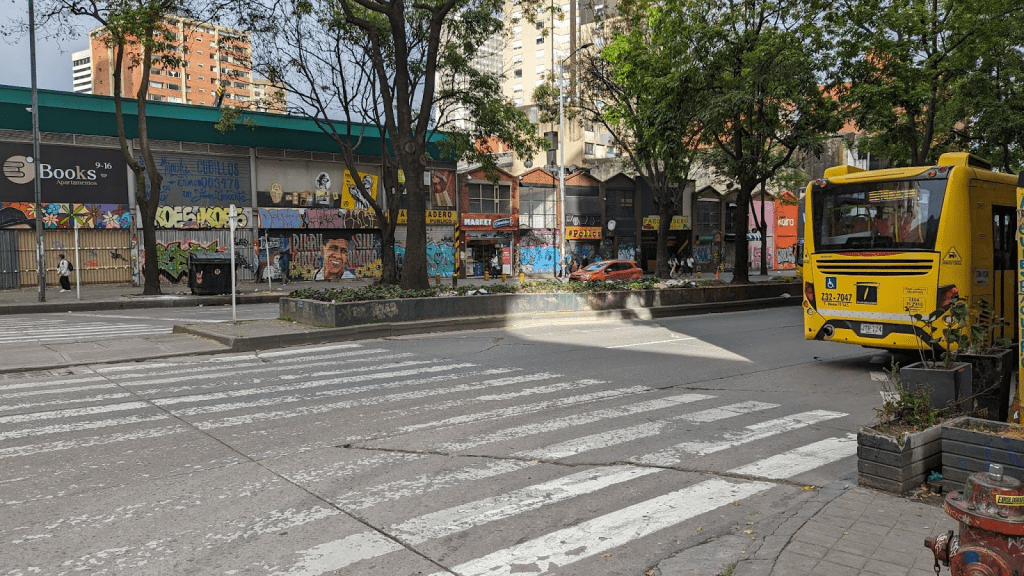
The intersection of Calle 19 with Carrera 4 in August 2023. Dilan fell on the crosswalk on the bottom left of the image above after a police officer shot him in the head with a pellet bean bag. The officer had been standing approximately where the red car is in the image when he shot Dilan on November 23, 2019.
This was my first time being in a place that I knew from an investigation that I had conducted.
I started doing open source research on Venezuelan anti-government protests in 2014, and throughout the years I’d become familiar with many streets and intersections there via videos and images from demonstrations. But I’d never visited any of them. And, since joining Bellingcat in 2018, I’d worked on many cases involving videos and pictures from the scenes of killings and atrocities.
As an open source investigator, you become deeply familiar with places that you’ve never been to, and to which you may never go.
There is a pervasive privilege there. I watch atrocities happen elsewhere from the comfort of my home. When I first watched Dilan Cruz fall, I did so from my living room in my apartment in Toronto. I’ve never smelled tear gas. I’ve never heard a weapon fired, nevermind had one aimed at me. I’ve never been part of a crowd on a street demanding my rights.
Part of the disorientation that I felt that day was not just due to the uncanniness of being in that place for the first time, having become so familiar with it in videos.
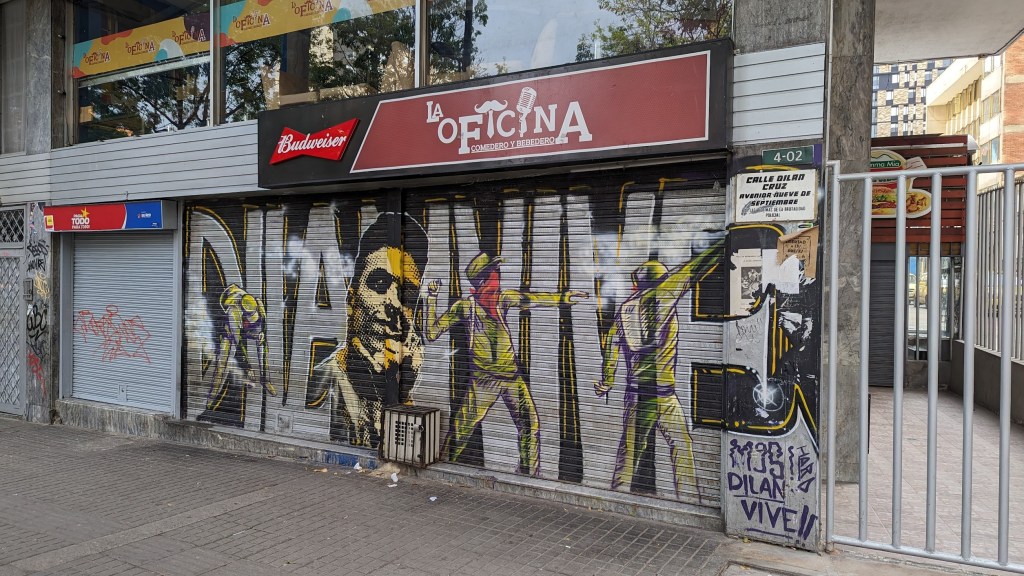
There are many murals commemorating Dilan at the intersection. This one reads “Dilan Vive” (Dilan Lives). Note the white sign on the right side of the screen listing the street’s unofficial name: “Dilan Cruz Street”.
What I experienced challenged not just my spatial memory of that intersection, but also my subjective experience of the space. Standing there, on the spot where Dilan Cruz was shot, I saw the intersection as he must have seen it before he died. I saw the intersection not through my eyes of the privileged researcher, but from the standpoint of those who were there that day, of Dilan himself.
I had the privilege of being there, and then going home.
 Giancarlo Fiorella
You must be logged in to post a comment.